
7 Exhibit Design Moves That Cut Drayage Costs
Last Updated: October 29, 2026
Quick Summary
You cut drayage costs by designing fewer, lighter, denser shipments before the design is locked, since weight and crate count set the bill. Specify lightweight materials, consolidate crates, and confirm the contractor's dimensional weight formula early. A design change that removes two crates often saves more than a cheaper freight carrier ever could.
Drayage is billed on total shipping weight and piece count, plus special handling and empty crate storage.
Aluminum extrusion frames are 40-60% lighter than steel for structural walls and towers.
Fabric graphics over frames are 80-90% lighter than rigid printed panels for backwalls.
Ask the contractor for the dim factor, often 194 or 166, and whether they round up.
Run a post-show audit comparing the itemized invoice to your advance quote and shipping manifest.
Table of Contents
How Exhibit Design Drives Trade Show Drayage Costs
Drayage costs are the material handling fees a show's general contractor charges to move your exhibit from the loading dock to your booth space and back. Exhibitors often blame the contractor for a shocking invoice when the real driver was a design decision made months earlier. Weight and crate count set the bill before your freight ever leaves the shop.
What Drayage Actually Covers
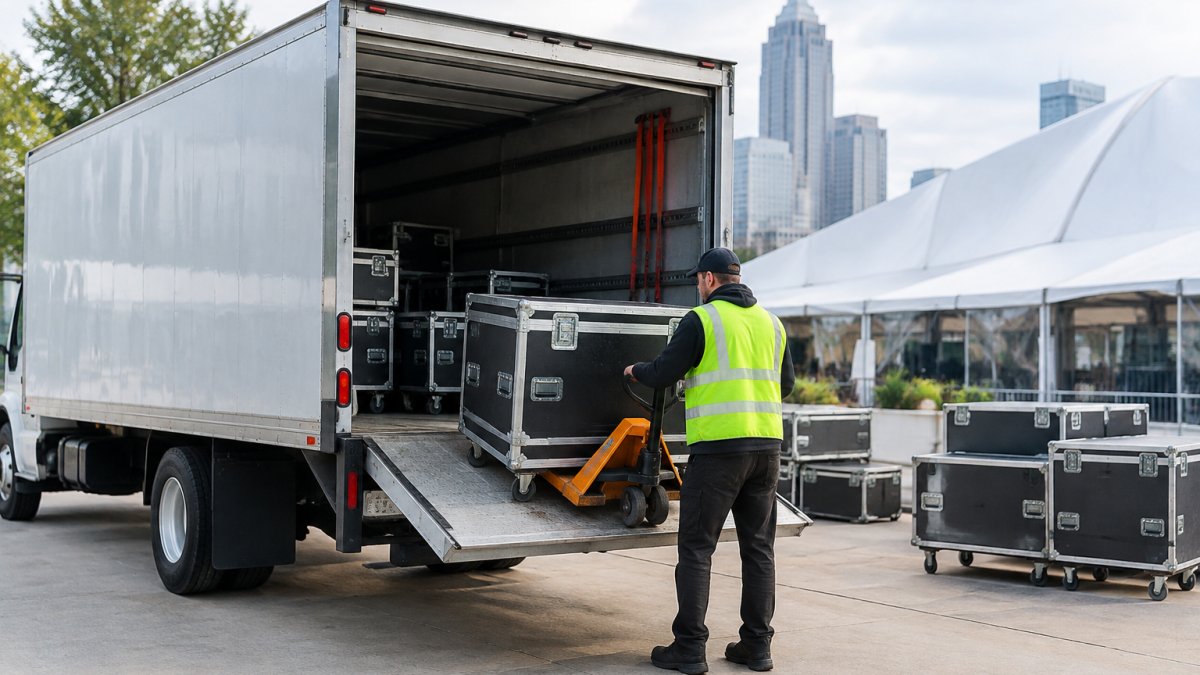
Drayage is the short-haul handling of your exhibit on show property. It starts when your freight arrives at the dock and ends when it returns to the carrier.
The general contractor handles several separate tasks:
Unloading crates from your carrier
Moving them to your booth space
Holding empty crates during the show
Each task can bill separately. That's why a single line item rarely tells the full story.
Why Weight and Crate Count Rule the Invoice
Two numbers drive most material handling invoices: total shipping weight and the number of pieces you send.
Many contractors bill on dimensional weight when a crate is bulky but light. More crates mean more forklift trips, more labor hours, and more storage fees.
The lesson is simple. Design fewer, lighter, denser shipments and the invoice shrinks on its own.
Run the Numbers: A Drayage Calculation Breakdown
Most exhibitors never see how the number is built. Ask for the rate sheet in the exhibitor manual and you'll usually find four inputs.
Here's the framework we walk clients through:
Billing Input | What It Measures | Design Lever |
Weight | Total pounds or dimensional weight | Lightweight materials, hollow-core panels |
Piece count | Crates plus loose items | Consolidate into fewer crates |
Special handling | Hand-carried or un-crated items | Crate everything, label clearly |
Storage | Empty crate hold during show | Smaller crates, collapsible options |
Multiply each input by the contractor's published rate, then add surcharges. When you model it this way, a design change that removes two crates often saves more than a cheaper freight carrier ever could.
Specify Lightweight Exhibit Materials Before the Renderings Freeze
The cheapest time to cut weight is before the design is locked. Once a rendering is approved and fabrication starts, swapping materials means re-engineering, and that costs more than it saves.
Breakthrough Productions
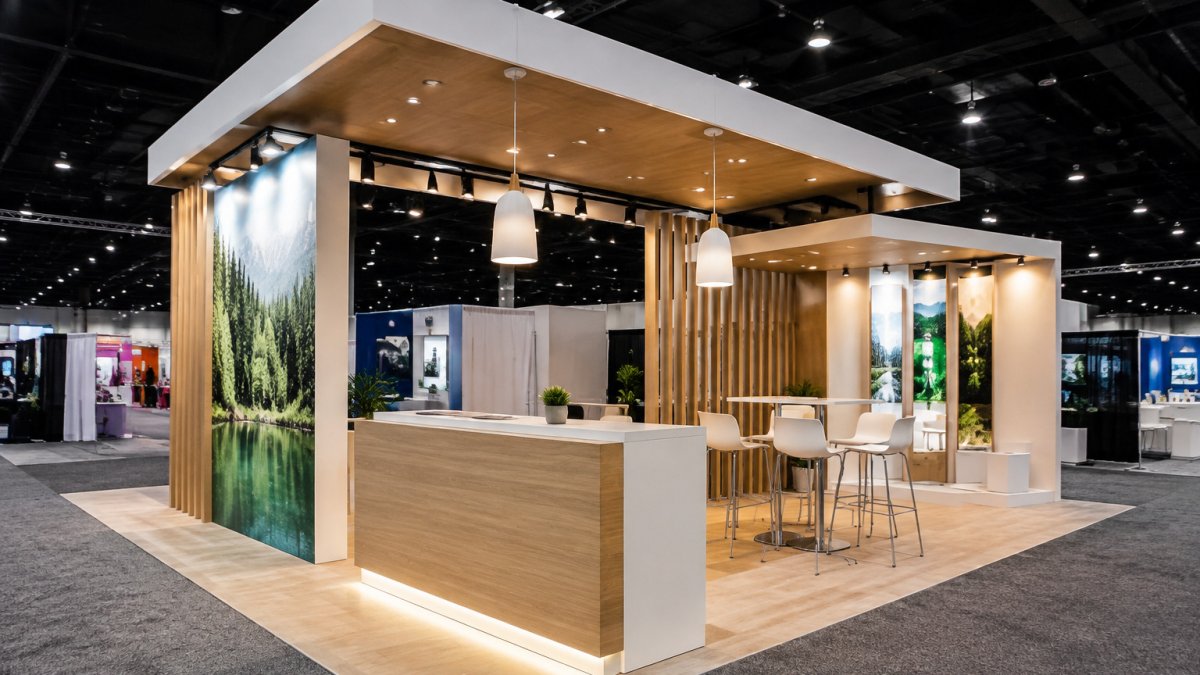
A common mistake is defaulting to heavy sheet goods and solid millwork for every surface. In practice, most walls and towers don't need that density.
The Dimensional Weight Trap
Most contractors bill on dimensional weight, not actual scale weight. That means a crate that's bulky but light still gets billed as if it were heavy.
The design lever: pack denser, not just lighter. A hollow tower that ships in its own oversized crate can cost more in drayage than a solid wall that nests into a standard pallet footprint.
Material Trade-Offs That Actually Matter
Here are common material swaps to consider:
Material | Weight vs. Traditional | Best Use | Watch-Out |
Aluminum extrusion frame | 40-60% lighter than steel | Structural walls, towers, hanging signs | Needs proper gusseting for tall spans |
Honeycomb composite panels | 50-70% lighter than MDF | Flat walls, counters, header panels | Edge finishing required; not for curved surfaces |
Fabric graphics over frames | 80-90% lighter than rigid printed panels | Backwalls, banners, tensioned displays | Requires frame engineering; wrinkles if tension is off |
Engineered wood (plywood, MDF) | Baseline | Load-bearing structures, premium finishes | Heavy; use only where structure or finish demands |
Foam-core / corrugated | 90% lighter than wood | Temporary signage, low-stress panels | Not durable for multi-show reuse |
A practical rule: decide the material palette while the concept is still soft. If you want a deeper comparison of frames, graphics, and panels for weight and reuse, see our guide on choosing materials for durable trade show exhibits.
The Sustainability Angle Competitors Miss
Lightweight design can also reduce the footprint of a shipment. Every pound you remove from a shipment reduces fuel burn in the truck that hauls it to the venue and the forklift that moves it on-site. For brands with public sustainability commitments, the drayage reduction is a measurable line item in the event carbon footprint.
How to Specify Lightweight Materials in a Design Brief
Don't leave material selection to the fabricator's default. Put it in the brief:
State a target shipping weight per crate (e.g., "no crate over 500 lbs actual weight")
Specify maximum crate dimensions to avoid dimensional weight penalties
Require a material callout on every major component in the rendering package
When you specify early, you give the fabricator room to engineer around weight instead of retrofitting after the fact. That's where the savings live.
Modular Trade Show Exhibit Design That Ships Smarter
Modular trade show exhibit design is the practice of building an exhibit from standardized, interchangeable components so it packs into fewer crates and adapts to different booth sizes.
Why it works: standardized crates stack tighter, ship denser, and get handled faster. A modular architecture also lets you reuse the same kit across a bigger island and a smaller inline space without new fabrication.
Design for Reuse and Storage
Reuse only pays off if the components survive the road. Build in these habits:
Standardize crate footprints so they palletize together
Label every component with a location map
Use durable finishes that tolerate repeated handling
For the full playbook on modular standards, graphics updates, and lifecycle cost, read how to design reusable components for trade show programs.
Trade Show Exhibit Shipping Crates: Fewer, Lighter, Better

Crate strategy is where design meets logistics. A well-built crate protects the exhibit and cuts handling at the same time.
Start with crate count. Consolidating three half-full crates into two full ones reduces piece count and forklift trips.
Consolidate Freight and Choose the Right Shipping Lane
Freight consolidation means combining multiple shipments into one so the contractor handles fewer arrivals. Decide early between advance warehouse shipping, which delivers to the warehouse ahead of the show, and direct-to-show, which arrives on site.
If shipping is eating your budget, our breakdown of alternatives to traditional trade show shipping compares 3PLs, freight marketplaces, LTL carriers, and van lines, plus ways to cut drayage.
Negotiating Material Handling With the General Contractor
You have more room to negotiate than most exhibitors assume. The rate sheet is a starting point, not a fixed law. But negotiation isn't about being aggressive, it's about knowing which levers exist and asking for them before the show, not after.
The Questions That Actually Move the Number
Most exhibitors ask, "What's the rate?" The better questions are structural. Here's the script we give clients before they call the general contractor:
"Can you send the full material handling rate sheet and the surcharge schedule?" The rate sheet is often buried in the exhibitor manual or available on request. Get it in writing.
"How do you calculate dimensional weight for crates?" Confirm the dim factor (194 vs. 166) and whether they round up. A small difference in the divisor can swing the bill.
"What triggers special handling?" Ask for the specific criteria, un-crated items, hand-carried freight, items over a certain weight, or anything that can't be forklifted. Design around those triggers.
"Is there a target move-in window that avoids overtime labor?" Overtime rates are often higher than standard rates. Ask for the window and plan your freight to hit it.
"Can we consolidate multiple shipments into one arrival?" Some contractors charge per shipment or per delivery window. Consolidation can reduce both drayage and administrative fees.
"What's the process for disputing a charge after the show?" Know the deadline and the documentation required before you need it.
The Advance Warehouse Lever
Advance warehouse shipping is often cheaper than direct-to-show, but not always. The trade-off: advance warehouse gives you a scheduled delivery window and avoids overtime dock rates, but it adds a warehouse handling fee. Direct-to-show can be cheaper if your freight arrives during standard hours and you're willing to manage the timing. Ask the contractor for both scenarios in writing and compare the total, not just the drayage line item.
What to Watch Out For
Signing off on an estimated material handling form without reading the surcharge list is how surprise line items appear. Common surcharges include:
Overtime or after-hours labor
Special handling for un-crated or hand-carried items
Storage fees for empty crates held longer than the standard window
Get the rules in writing. Venue rules and the fire marshal walkthrough also affect what you can install, so review venue regulations for custom installations before finalizing the design.
The Post-Show Dispute Playbook
If the invoice doesn't match the quote, you have recourse, but only if you documented the inputs. Before the show, save:
The advance quote and rate sheet
Your shipping manifest with actual weights and piece counts
Photos of your crates at load-in (with labels visible)
After the show, compare the invoice line by line. If billed weight exceeds your manifest, request the scale tickets. If piece count is off, request the dock receipt. Documentation helps when disputing obvious billing errors.
Pro Tip Ask for the contractor's dispute deadline in writing before the show. Some contractors set dispute deadlines, so confirm the timing before the show.
The Post-Show Drayage Audit: Find the Leaks
The invoice arrives weeks after the show, and most teams pay it without a second look. That's a mistake.
Run a simple audit after every show:
Compare the itemized invoice to your advance quote
Check billed weight against your shipping manifest
Count billed pieces against your actual crate count
Repeated audits can reveal patterns such as the same oversized crate, loose item, or surcharge. Fixing the design, not just the invoice, is where cost control becomes a habit.
Send Us Your Rendering for a Drayage Reality Check
Here's the challenge: your next design is approved, the show date is locked, and nobody has modeled what it will cost to move.
That's exactly where we work. Breakthrough Productions designs, engineers, fabricates, ships, and installs exhibits nationwide, so weight and crate problems can be addressed before they reach the dock.
Send us your rendering and we'll pressure-test it for drayage before fabrication starts. Visit our custom tradeshow displays and exhibits page to start the conversation.
Frequently Asked Questions
What is trade show drayage and how is it calculated?
Drayage is the material handling charge for moving your exhibit from the advance warehouse or show site dock to your booth space, plus empty crate storage and return. The general contractor bills it by shipment type and weight, often rounding up to the next hundredweight, so a booth that lands just over a threshold pays for the full next unit. Special handling surcharges apply to crates that cannot be forklifted or that arrive without proper paperwork. The exhibitor manual for your specific show lists the rates and rules.
How can exhibit design reduce drayage costs?
Design decisions set the weight and crate count long before the invoice arrives. Specifying lightweight exhibit materials such as aluminum extrusion, fabric graphics, and composite panels trims shipping weight. Modular trade show exhibit design lets you pack components tighter and reuse crates across shows. Consolidating freight into fewer, forklift-friendly crates avoids loose-piece handling surcharges. Bring your fabricator into the design conversation early so weight and packing are treated as design constraints, not afterthoughts.
Do smaller or lighter exhibit crates really reduce drayage costs?
Yes, because most material handling is billed by weight and by shipment, not by how impressive the booth looks. Fewer crates mean fewer line items and less chance of a special handling fee for loose or unstackable pieces. Lighter crates lower the billed weight, and crates sized to standard pallet footprints move faster on the dock. The savings compound across a multi-show schedule, which is why reusable crate systems are worth planning for from the first build.
What should exhibitors ask their general contractor about material handling?
Ask for the rate sheet in the exhibitor manual before you finalize the design, and confirm how weight is rounded and what triggers special handling. Ask whether advance warehouse shipping is cheaper than direct-to-show for your arrival window, and what the deadline is. Request a sample invoice breakdown so you can see how crates, pallets, and loose pieces are billed. Then compare the post-show invoice line by line against your shipping manifest. Catching one misclassified crate often pays for the audit.
Your exhibit shouldn't cost more to move than it did to build. Bring us the concept, the rendering, or just the objective, and we'll find the smartest way to design, ship, and install it. Get started with Breakthrough Productions and put your next show on a lighter, cheaper footing.

Comments